On a chilly Tuesday morning, a Park University student circled the main academic lot three times before giving up. They parked near the softball fields — an eight-minute uphill walk — and still rushed into a 9 a.m. class a few minutes late.
“It happens almost every day,” the student said. “If you’re not here by 8:15 (a.m.), you’re parking somewhere in Kansas.”
They laughed, but many students share the same frustration.
Parking at Park University has become a daily struggle for commuters navigating packed lots, long walks, and an unpredictable search for a spot. A campuswide survey, which collected student responses on parking difficulty, walking distance, and lateness to class, shows the reality they face.
Growing pressure on a growing campus
As Park University has updated facilities, parking availability has not kept pace. Lots surrounding Park’s Academic Underground building, Copley-Thaw Hall, and Norrington Center were built decades ago, before commuter traffic increased.
Peak times — roughly 8 a.m. to 12 p.m. — are the most congested, with cars circling the same few lots.
Survey findings support what students describe. When asked, “How easy is it for you to find parking on campus?”, the majority rated parking as difficult or very difficult.
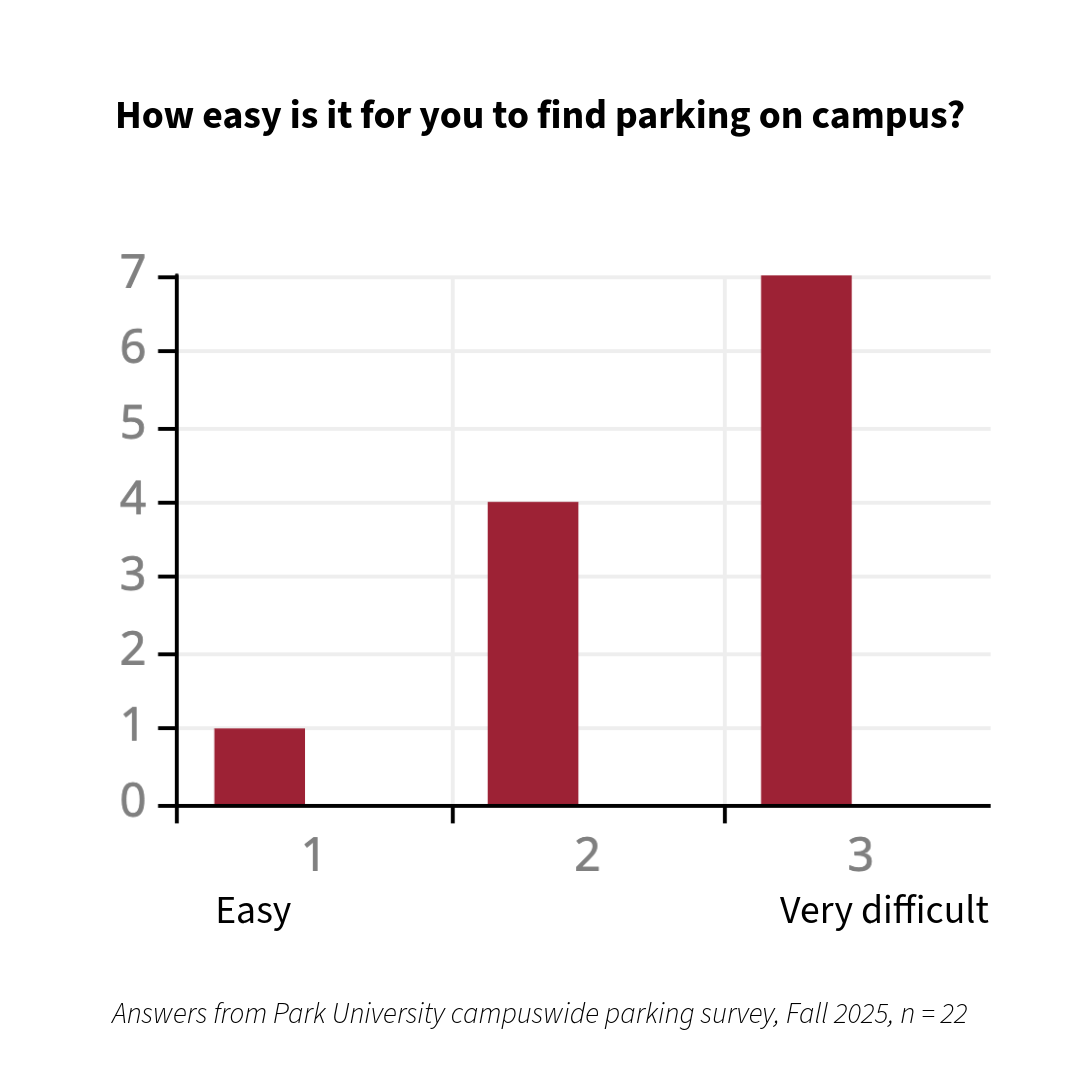
Seventy-three percent of respondents said rated “finding parking” as difficult or very difficult. In addition, 62% said they parked farther than comfortable and 41% said parking made them late or nearly late to class. Finally, 58% identified 8 to 11 a.m. as the worst time to park
‘I leave 15 minutes earlier than I should have to’
One student, who noted they live less than 15 minutes from campus, said they now leave almost 40 minutes before class because of parking.
“I’m not worried about traffic,” the respondent wrote. “I’m worried about finding a spot.”
They said they usually end up near one of the farthest student-accessible lots. The walk is manageable in good weather, but difficult in rain, snow, or ice.
Other students gave similar responses. One wrote, “I’ve had to sprint to class more than once.” Another student stated, “Sometimes I don’t even try the academic lot because I know it’s full.” One student even wrote, “It feels like a lottery.”
Students said arrival time has become a strategic calculation rather than a simple commute. Several have said their mornings hinge on luck.
Safety concerns rise with walking distance
Students also raised safety concerns when parking far from campus buildings, especially in the evening.
One student wrote, “Walking back after evening classes doesn’t feel great. Some areas are dark and really far.”
Another said the farther athletic lots feel isolated after sunset.
Park University is considered a safe campus overall, but the combination of distance, poor lighting in certain areas, and student foot traffic has led to heightened concerns.
A representative from the Department of Campus Safety confirmed that they hear similar complaints from students. “We mainly hear that the lots closest to academic buildings fill up quickly in the mornings, which can make it harder for students who arrive later to find a closer space,” the representative wrote, adding that they report their observations about parking and safety to Park’s university administration. “Our job is to ensure safety across all areas of campus, including parking lots. We monitor the campus, respond to calls, and assist students when needed. We encourage students to report concerns and reach out if they ever feel unsafe walking to or from their vehicles. We are here as a resource.”
Students propose practical solutions
Students offered realistic suggestions when asked what changes they want to see. Those suggestions including the following:
- More parking spots near academic buildings
- Clearer directional flow to cut down on circling
- A small shuttle or golf-cart service from the far lots
- Better communication about available lots
- Updated signage around campus
One student wrote, “I didn’t know the lot behind the athletics building existed until halfway through the semester. A map would help.”
Another wrote, “Even arrows or signs to guide morning traffic would help.”
Students said they understand that large changes may take time, but many feel smaller improvements could ease daily frustrations.
Stress before class even begins
Some students said the parking situation affects their morning mindset before class starts.
“Parking can ruin your morning,” one student wrote. “You start your day already stressed.”
Some said they felt rushed, sweaty, or anxious by the time they got to class. Others admitted they had considered skipping class when they couldn’t find a spot fast enough.
For students balancing work, families, and coursework, delays caused by parking become another hurdle in an already full day.
What students want to see next
Students believe there are reasonable expectations for the future at Park. Some of the changes they would like to see implemented include shorter walking distances, improved morning traffic flow, better awareness of overflow parking and incremental updates that don’t require major construction. Finally, one investment they wanted to see is providing students with real-time updates on lot availability.
One student wrote, “I don’t need a spot right up front. I just don’t want a 10-minute uphill walk.”
Parking at Park University affects more than convenience. It affects schedules, safety, and stress levels. Survey data, student responses, and conversations with Campus Safety all point to the same conclusion: students want change. For now, though, the search for parking remains a daily ritual many students wish they could avoid.